
considerations for mixed-technology circuit board assembly services
In the realm of circuit board assembly services, solder masks play a pivotal role in ensuring the reliability, performance, and longevity of electronic devices. Solder masks are protective coatings applied to the surface of printed circuit boards (PCBs) to insulate conductive traces, prevent solder bridges, and enhance solderability during the assembly process. In this article, we explore the multifaceted functions and significance of solder masks in circuit board assembly services.
One of the primary functions of solder masks is to insulate and protect conductive traces on the PCB from environmental factors such as moisture, dust, and contaminants. By covering the conductive traces with a non-conductive layer, solder masks prevent short circuits and electrical failures that can occur due to exposure to external elements. This insulation ensures the reliability and durability of electronic devices, particularly in harsh operating environments.
Solder masks also serve as a barrier between solder and non-solder areas on the PCB, preventing solder from spreading beyond designated areas during the assembly process. This prevents solder bridges, which occur when solder unintentionally connects adjacent conductive traces, leading to electrical shorts and malfunctions. By delineating solderable and non-solderable areas, solder masks facilitate precise soldering and assembly, minimizing defects and improving overall manufacturing yield.
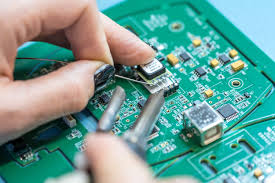
What are the considerations for mixed-technology circuit board assembly services?
Moreover, solder masks enhance solderability by providing a flat, even surface for solder deposition and reflow. The smooth surface of the solder mask promotes proper wetting and adhesion of solder to the exposed copper pads, ensuring strong and reliable solder joints. This is especially critical for surface-mount assembly, where solderability is essential for achieving consistent and robust connections between components and the PCB.
Another essential function of solder masks is to improve the visual clarity of the PCB and facilitate inspection and troubleshooting during the assembly process. The contrasting color of the solder mask against the underlying substrate and copper traces enhances the visibility of the circuitry, making it easier for technicians to identify defects, such as solder bridges, opens, and misalignments, using optical inspection techniques.
Furthermore, solder masks provide protection against soldering flux residues, which can accumulate on the surface of the PCB during the assembly process. Flux residues are corrosive substances that can degrade the performance and reliability of electronic devices over time if left unchecked. By encapsulating the solder joints and preventing direct contact with flux residues, solder masks mitigate the risk of corrosion and ensure the long-term integrity of the PCB.
When selecting a solder mask for circuit board assembly services, manufacturers must consider various factors such as material compatibility, thermal stability, adhesion properties, and regulatory compliance. Common solder mask materials include epoxy, polyurethane, and liquid photoimageable (LPI) solder masks, each offering unique advantages and characteristics suited to different applications and assembly processes.
In conclusion, solder masks play a critical role in circuit board assembly services by providing insulation, preventing solder bridges, enhancing solderability, improving visual clarity, and protecting against environmental factors and flux residues. By understanding the functions and significance of solder masks, manufacturers can optimize the assembly process, minimize defects, and ensure the reliability and performance of electronic devices in diverse applications.